When manufacturers evaluate a new hydraulic or electric servo press, the conversation usually starts with obvious specifications. Tonnage, bed size, stroke, and cycle speed all come up early, and for good reason. Those numbers determine whether the machine can do the job at all. But there is another factor that rarely appears on a spec sheet and often matters just as much over the life of the press. That factor is where the press is designed, built, and supported.
As reshoring reshapes American manufacturing, more buyers are asking not only what a press can do, but who stands behind it once it is on the floor. The answer to that second question shapes lead times, service responses, parts availability, and the kind of engineering relationship a buyer can expect for the next twenty or thirty years. This article looks at why the location of a press builder deserves real weight in the decision, and what to ask before you sign.
For much of the past two decades, the deciding factor in many equipment purchases was simply price. Global supply chains made it possible to source machinery from almost anywhere, and the lowest quoted number frequently won. That calculation is changing.
Recent reshoring research makes the shift clear. In the 2025 USA Reshoring Survey, manufacturers indicated they would bring more production back to the United States if the domestic skilled workforce existed, ranking workforce availability ahead of tariffs, currency shifts, and tax policy. In other words, the barrier is no longer mainly about cost. It is about capability and reliability close to home. As that mindset spreads, it naturally extends to capital equipment. A press is not a commodity part. It is a long-term production asset, and buyers are beginning to weigh the dependability of the supplier as heavily as the quoted price.
“When a press goes down, the first question is never about the original purchase price,” said Jon Schmidt, Vice President at Neff Press. “It is about how quickly you can get the right person on the phone and the right part in the building. That is where the location of your press builder matters.”

One of the clearest differences between press builders is how much of the work actually happens under one roof. Some manufacturers assemble machines from designs and components sourced from several outside parties. Others handle the mechanical, hydraulic, and electrical engineering in-house, as a single coordinated effort.
The distinction matters more than it might first appear. When a press is designed in-house, the people who engineered the machine are the same people a customer can reach later with a question. There is no translation layer between the buyer and the original intent of the design. If a tooling change calls for a new part, or an application evolves and needs a revised control sequence, the institutional knowledge is still in the building.
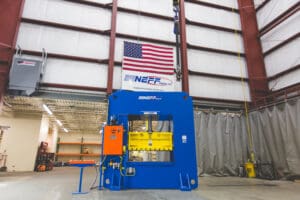
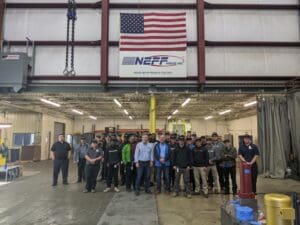
Everything engineered at Neff Press is done in-house, without outsourcing the design work. A project engineer is assigned to each job and stays with it from the initial design through commissioning, regardless of the size of the project. For the buyer, that continuity means the person who understands the machine best is also the person accountable for it. As a result, conversations about modifications, retrofits, or troubleshooting tend to be faster and more direct, because the answer does not depend on tracking down a third party who built one subsystem years earlier.


Domestic manufacturing also changes the arithmetic of time. When a press is built overseas, the distance introduces friction at several points. Shipping is slower and more expensive. Customs and logistics add unpredictability. And when a critical component fails, the replacement may have to travel a long way before production can resume.
For a high-volume operation, waiting has a real cost. A press that sits idle while a part crosses an ocean is not just an inconvenience. It is lost output, missed delivery dates, and pressure on every downstream commitment. A domestic builder shortens that loop. Parts are sourced and stocked closer to the customer, service technicians can reach the site sooner, and the path from problem to solution is simply shorter.
“We design our machines so the replacement components can be sourced here, not just from a single supplier on another continent,” Schmidt explained. “That is a deliberate choice. A press should keep running for decades, and the parts strategy has to support that, not fight it.”
This is also why component standards deserve attention during the buying process. A press built around widely available, industry-standard hydraulic, electrical, and control components is easier to maintain over its life than one built around proprietary parts that are difficult to obtain. Buyers should ask not only what is inside the machine, but how easily those parts can be replaced years from now.
There is a further advantage to a builder that designs to the standards a U.S. facility has to meet. American presses are typically engineered around the codes and expectations that govern domestic plants, including UL, NFPA, OSHA, and ANSI requirements. When a machine is designed with those standards in mind from the start, compliance is built into the press rather than retrofitted onto it.
Neff Press engineers to UL 508a certification and to NFPA 70 and NFPA 79 for electrical design, and aligns with ANSI B11.2, CSA Z142, and applicable OSHA standards. A Neff engineer sits on the ANSI B11.2 committee, which means the people building the press are also part of the conversation that defines the safety expectations for this class of equipment. For explosion-proof applications, designs comply with NEC 505 and ATEX. For the buyer, this kind of direct involvement in the standards is hard to replicate from a distance, and it removes a great deal of uncertainty about whether a machine will pass inspection and protect the people who run it.
Perhaps the most underappreciated benefit of a domestic press builder is the relationship itself. A press is not a one-time transaction. It is a piece of equipment that a plant will rely on for a generation, and over that span the needs around it will change. New products, new materials, new tooling, and new safety expectations all arrive over time.
A press builder that is nearby, with the original engineers still available, can support those changes as they come. Retrofits, control upgrades, and application adjustments are far easier when the people who built the machine are still reachable and still understand it. With more than sixty years of press building and over thirteen thousand presses delivered since 1965, Neff Press has had the chance to support customers through exactly these kinds of long arcs, where a press purchased for one application is adapted years later for another.
“The goal is not to sell a press and move on,” Schmidt said. “The goal is to still be the company you call ten or fifteen years later, when the job has changed and the machine needs to change with it. That is a lot easier to do when we are built and based right here.”
Location is not the only thing that matters in a press purchase, and it should not crowd out the fundamentals of force, accuracy, and fit for the application. But it belongs on the list, and a few direct questions can reveal how much it will affect the years after delivery.
The lowest quoted price is easy to see at the moment of purchase. The cost of slow service, scarce parts, and a distant engineering team is harder to see up front, but it accumulates over the life of the press. For manufacturers thinking in decades rather than quarters, the location of the builder is not a detail. It is part of the value of the machine itself.
A well-built press should perform on day one. A well-supported press should still be performing, and still be adaptable, long after the purchase is a distant memory. For buyers weighing those two horizons, where a press is built and supported is a question worth asking early, and worth answering with care.